
Banc d'Arguin National Park
Highlights: El Beyed – Ouadane – Guelb Er Richat – Chinguetti – sailboat cruise – Banc d’Arguin – the atmosphere of the ore train – the Ben Amira monolith.
This tour can be taken from Nouakchott.
J 1 Paris - Atar
Departure from Paris (charter flight) to Atar. Meal and overnight stay at the Auberge du Bonheur.
J 2 Sebkha Chemchan - Inselberg d'Aderg
We leave the paved road at the northeast exit of the city of Atar and take dirt tracks—sometimes sandy—through the foothills of the Adrar. Visit the medieval house (built around 1480) of Mauritania’s greatest religious leader. Picnic. In the afternoon, we cross (on dry land) the large Paleolithic lake of Chemcham. We arrive in the late afternoon at our campsite in the Erg Makteir, facing the Aderg inselberg. Camp.
J 3 Aderg - El Beyed
Departure in the morning for El Beyed, Mauritania’s largest Paleolithic site; visit the rock art site and the Museum of Prehistory. Camp overnight.
J 4 El Beyed - Richat
We set out in the morning for Guelb Er Richat, a large crater nicknamed “the Eye of the Earth” and a true geological enigma; truly exceptional! Overnight camp.
"The most widely accepted explanation is that a magmatic dome formed at the intersection of fault lines approximately 100 million years ago and ceased growing before the dome could become a volcano. The ancient Cambrian sandstones, uplifted by the dome’s formation, were subsequently shaped by fractures and erosion to form this system of concentric cuestas that today gives Richat its somewhat mysterious character. After initially interpreting it as an astrobleme (a meteorite impact structure), geologists considered a symmetrical uplift (a circular anticline). But Th. Monod, who studied this phenomenon with a few colleagues, published, nearly half a century ago (Monod and Pomerol, 1973), hypotheses very close to the explanation commonly accepted today. Thus, since around 1980, it has been established that the Richat Structure is an “alkaline complex” resulting from a specific form of volcanism dating back 100 million years (Cretaceous: late Mesozoic era) that created a magmatic dome associated with hydrothermal activity (circulation of very hot water under extremely high pressure) This complex formed during the opening of the Atlantic Ocean.”
J 5 Guelb Er Richat – Ouadane
We depart early in the morning from Guelb Er Richat and head toward the historic town of Ouadane. We pass by the ruins of Agoueidir Fort, the clay remains of a Portuguese fort built around 1446. We tour the old town of Ouadane. Overnight at a guesthouse.
“Ouadane, formerly known as Iwaden (a Berber name), which was corrupted to Ouadane in Arabic, means ‘the two wadis’: the wadi of knowledge, which is the city, and the wadi of dates, which is the valley. Ouadane remains a magnificent ancient city in Mauritania, founded in the 11th century and listed as a UNESCO World Heritage Site. It remains a city steeped in history and impresses all travelers who set foot in the Adrar region. The old part of the area overlooks a hill and catches the eye with its magnificent ruins.”
J 6 Ouadane - Tenochert - Mezrougatt
We leave Ouadane via the sand dunes, heading due west. We stop for a picnic in the beautiful little palm grove at Tenochert before exiting Herour
(an esker formed by a powerful glacial river) through a narrow pass, heading toward the small semi-nomadic camp of Rghewiya. We set up camp in the middle of the
dunes of Efam El Mezrougatt.
J 7 Mezrougatt - Chinguetti - Zarga
Departure in the morning for the town of Chinguetti, passing through the beautiful dunes of Mezrougatt. Visit one of the oldest libraries (ancient manuscripts) and the ruins of the ancient city of Chinguetti, considered the seventh holy city of Islam.
“Chinguetti has about ten libraries, four of which are open to the public. Some items in these collections date back to the 11th century, including some written on gazelle skins. Most of these works deal with religion and the Quran, but many cover science, geometry, or literature.
The city has been listed as a UNESCO World Heritage Site since 1996.”
Departure in the early afternoon, following the sandy wadi toward Mount Zarga. Camp opposite the beautiful Tichilit El Ateg dune, which is the highest point of the Zarga massif and the third-highest peak in the Adrar range.
J 8 Zarga - Palmeraie de M'haïreth - Akjoujt
Early morning departure from Zarga, heading due west toward the M’haïreth palm grove. Lunch in the shade of the palm grove, then in the early afternoon, we continue our journey toward the Toungad palm grove and its beautiful guelta; we camp in the sandy Tiffoujar canyon.
J 9 Tiffoujar - Azoueïga - Akjoujt
We leave the Tiffoujar Canyon in the morning via a steep pass and head for the beautiful Azoueïga dune. We pass through the beautiful palm groves of Legleytat and El Aouja. Lunch break in Azoueïga. Then we continue our journey, driving between the Adrar Mountains and the Erg Amatlich. Camp near the mining town of Akjoujt.
J 10 Akjoujt - M’heijratt
We return to the paved road from Atar to Akjoujt to Nouakchott, which we leave at the mining town of Akjoujt (copper and gold mines) as we pass through it on our way to Benichab, a village famous for its mineral waters. We continue due west toward the Atlantic Ocean. We camp near M’heijratt.
11 M’heijratt - Iwik
From M’heijratt, we continue due north toward Iwik, rejoining the paved Nouakchott–Nouadhibou highway, which we’ll leave at Bouaamatou—about 250 km from Nouakchott—to head due west toward the Iwik Peninsula. Overnight at the inn.
J 12 Balade maritime
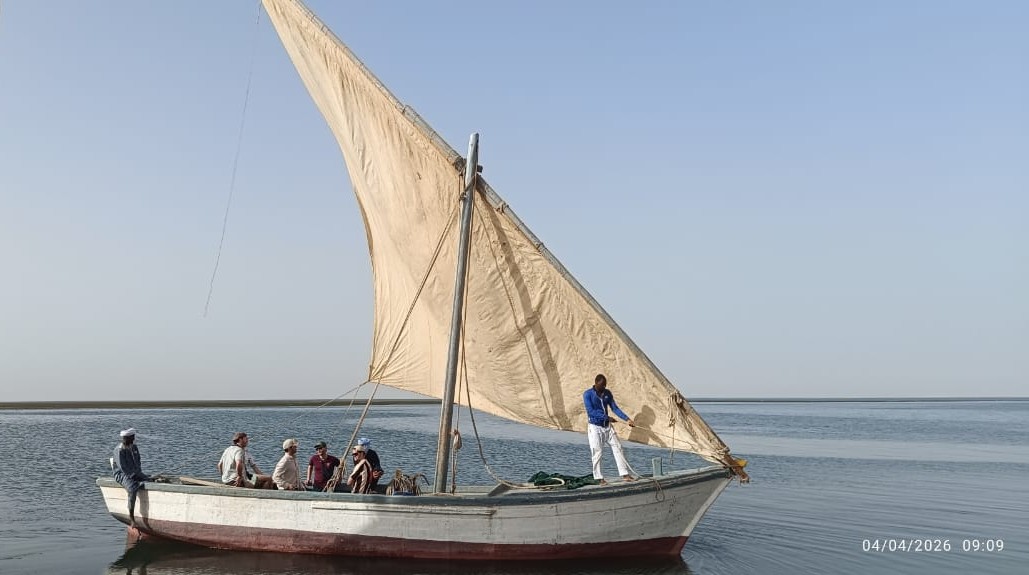
Our Imraguen fisherman friends take us on a beautiful cruise through the coastal section of Banc d'Arguin National Park aboard a locally built sailboat. We sail amidst thousands of resident and migratory birds.
This trip is a journey of discovery through the Banc d'Arguin National Park (PNBA), one of the largest parks in West Africa.
After the boat trip ends, a short drive will take us back to the beautiful site of Arkeiss. We’ll spend the night in tents on the beach.
J 13 Arkeiss - Chami - Ben Amira
We leave the village of Arkeiss early in the morning, heading for Chami, where we rejoin the paved Nouakchott–Nouadhibou highway. We leave this road 100 km north of Chami to take a scenic dirt track toward the railroad line connecting Nouadhibou (port) to Zouerate (mining town).
After a lunch break, we continue our journey parallel to the railroad tracks to the vicinity of the Ben Amira Monolith. The atmosphere is that of a ore train. Campout.
J 14 Ben Amira - Atar
After visiting the Aicha site (a modern art engraving commemorating the turn of the millennium), we head for Atar. We spend the night at the Auberge du Bonheur.
J 15 Atar - Paris
Transfer to the airport and flight to Paris.
