
Adrar Oriental
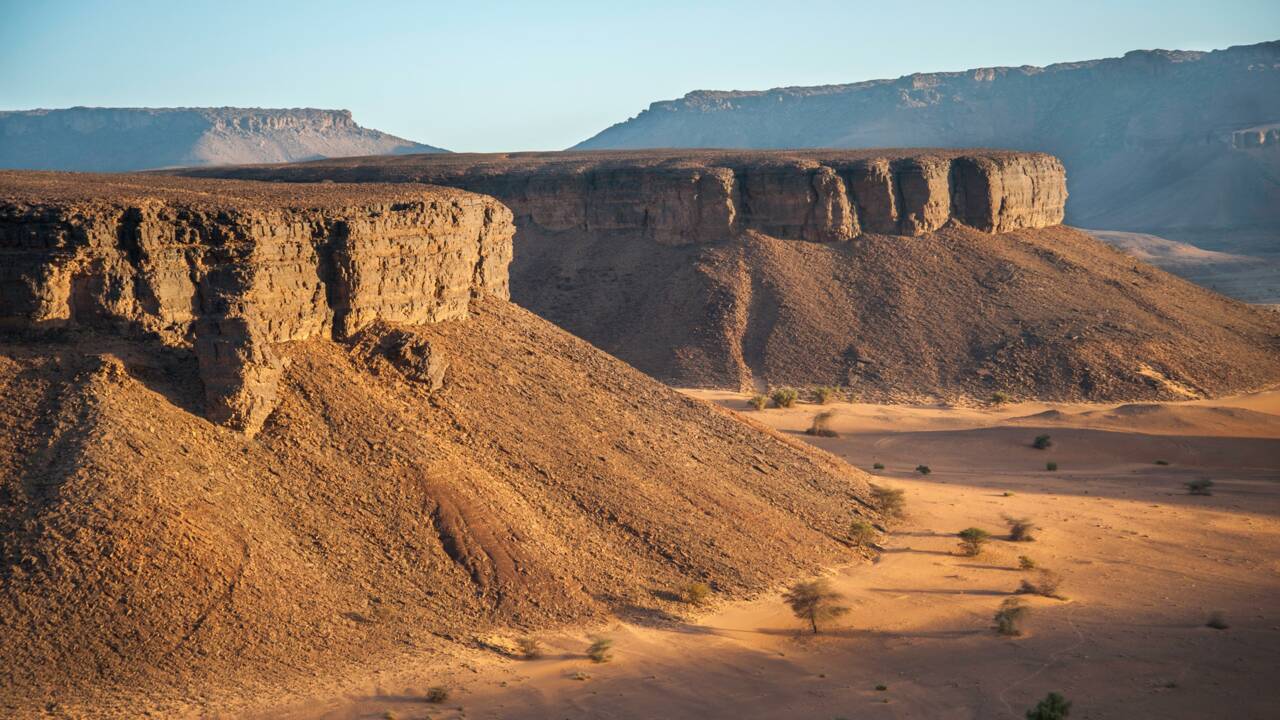
Adrar Oriental (ruta combinada en 4x4 y en camello, de 11 días, incluidos 4 días de senderismo; se puede realizar en 8 días, incluidos 3 días de senderismo)
La primera parte de este viaje consiste en un recorrido en coche por una de las regiones más bellas de Adrar (Adrar Oriental).
La segunda parte de este viaje es una excursión en camello por la impresionante zona de Erg Ouarane.
Puntos destacados: Chinguetti – Ouadane – El Beyed – Guelb Richat – el ritmo de la caravana de camellos – acampadas nocturnas.
TU VIAJE
J 1
Vuelo chárter a Atar, «la puerta de entrada al desierto mauritano», o vuelo regular a Nuakchot.
Una vez completados los trámites, nos reuniremos contigo en el vestíbulo del aeropuerto de Atar; tras un breve trayecto hasta la ciudad, llegaremos a nuestra pensión (Auberge du Bonheur), donde pasarás la noche.
J 2 Atar - Aderg - El Beyed
Salimos de Atar en dirección este, hacia las estribaciones del Adrar (el Baten).
Seguimos el acantilado del Adrar, pasando por el palmeral y el pueblo de Amder antes de llegar a «Dar Cheikh Mohamed Fadel» (el yacimiento consta de la tumba y la casa de un famoso líder religioso del siglo XVII). A continuación, cruzamos el lecho seco de la sebkha de Chemchame (el fondo arcilloso de un lago paleolítico), que se extiende a lo largo de 30 km.
Después seguimos el impresionante erg de Makteir, con sus hermosas dunas ocres y su imponente inselberg llamado «Aderg», antes de llegar al yacimiento paleolítico de El Beyed. Visita al yacimiento de arte rupestre y al Museo de Prehistoria. Acampada.
J 3 El Beyed - Guelb Er Richat - Ouadane
Por la mañana partimos hacia Guelb Errichat, un gran contrafuerte apodado «el Ojo de la Tierra» y un auténtico enigma geológico... ¡¡realmente excepcional!!
Visita a Guelb y al campamento arbolado conocido como «la Diócesis de Théodore Monod». Picnic.
«La explicación más aceptada es que hace unos 100 millones de años se formó un domo magmático en la intersección de líneas de falla y dejó de crecer antes de que pudiera convertirse en un volcán. Las antiguas areniscas cámbricas, elevadas por la formación del domo, fueron posteriormente moldeadas por fracturas y erosión para formar este sistema de cuestas concéntricas que hoy confiere a Richat su carácter algo misterioso. Tras interpretarlo inicialmente como un astroblema (una estructura de impacto de meteorito), los geólogos consideraron un levantamiento simétrico (un anticlinal circular). Pero Th. Monod, que estudió este fenómeno con unos pocos colegas, publicó, hace casi medio siglo (Monod y Pomerol, 1973), hipótesis muy cercanas a la explicación comúnmente aceptada hoy en día. Así, desde aproximadamente 1980, se ha establecido que la estructura de Richat es la de un «complejo alcalino» resultante de una forma particular de vulcanismo que se remonta a 100 millones de años (Cretácico: final de la Era Mesozoica) y que creó un domo magmático asociado a actividad hidrotermal (circulación de agua muy caliente a muy alta presión). Este complejo se formó durante la apertura del océano Atlántico.
Salimos de Guelb er Rîchat y nos dirigimos hacia el sur, en dirección a Hassi Thibat. Divisamos los restos del antiguo fuerte portugués de Agoueidir, construido hacia 1446, antes de llegar a Ouadane. Pasamos la noche en la posada.
«Ouadane, anteriormente conocida como Iwaden (un nombre bereber), se transformó en Ouadane en árabe, lo que significa “los dos uadis”: el uadi del conocimiento, que es la ciudad, y el uadi de los dátiles, que es el valle. Esta ciudad fortificada sigue siendo una magnífica ciudad antigua de Mauritania, fundada en el siglo XI y declarada Patrimonio de la Humanidad por la UNESCO. Sigue siendo una ciudad llena de historia e impresiona a todos los viajeros que pisan la región de Adrar. La parte antigua de la zona domina una colina y llama la atención por sus magníficas ruinas».
J 4 Ouadane - Tenochert - Mezrougatt
Salimos de Ouadane atravesando las dunas de arena, en dirección oeste. Hacemos una parada para comer al aire libre en el precioso y pequeño palmeral de Tenochert antes de atravesar un estrecho desfiladero para salir de Herour (un esker formado por un caudaloso río glacial). Llegamos al pequeño campamento seminómada de Rghewiya. Montamos el campamento entre las dunas de Mezrougatt.
J 5 Mezrougatt - Lemreyveg - Tweyiret
La ruta en camello comienza en Mezrougatt. Iniciamos nuestra ruta en camello a través de los hermosos valles entre dunas, en dirección a Lemreyveg, en el valle de Chinguetti. Montamos el campamento en una hermosa duna frente al pequeño palmeral de Tweyiret.
J 6 Tweyiret - Chinguetti
Continuando hacia el oeste, avanzamos por las hermosas dunas del Erg Ouarane hacia la antigua ciudad caravanera de Chinguetti, a donde llegamos alrededor del mediodía. Visitamos una de las bibliotecas más antiguas (que contiene manuscritos antiguos) y las ruinas de la antigua ciudad de Chinguetti, considerada la séptima ciudad más sagrada del Islam. Pasaremos la noche en la posada.
«Chinguetti cuenta con unas diez bibliotecas, cuatro de las cuales están abiertas al público. Algunos de los ejemplares de estas colecciones datan del siglo XI, incluidos algunos escritos en pieles de gacela. La mayoría de estas obras tratan sobre religión y el Corán, pero muchas abarcan temas de ciencia, geometría o literatura.
La ciudad figura en la lista del Patrimonio Mundial de la UNESCO desde 1996».
J 7 Chinguetti - les M'Ghalig
Dejamos atrás el casco antiguo de Chinguetti y partimos hacia Lagueyla. Se trata de un bonito y pequeño palmeral enclavado entre las dunas semicirculares de M'ghalig (valles interdunares), que en su día sirvieron como rutas comerciales para las caravanas transaharianas. Hacemos una parada para almorzar bajo las palmeras de Lagueyla.
A continuación, proseguimos nuestro viaje a través de las dunas, esta vez en dirección oeste.
Acampada en medio de las M'ghalig.
J 8 M'Ghalig - Tinouagherit
Sin salir de la región de M'ghalig, seguimos caminando por un paisaje de una belleza excepcional e inimaginable: extensos campos de dunas se extienden uno tras otro, todos muy parecidos entre sí, hasta que el erg de Ouarane llega a su fin al dirigirse hacia el oeste, en dirección a Tinouagherit. Haremos una parada para almorzar bajo una hermosa acacia.
Nuestra caminata de última hora de la tarde nos llevará a través de un reg pedregoso salpicado de barkhanes. Montaremos el campamento frente al monte Zarga.
J 9 Tinouagherit - Guelb Er Raoui - Zarga
Tras una buena media hora de caminata, llegamos al pequeño macizo de arenisca de Zarga, cerca del Guelb Eraoui. Visitamos la cueva de los murciélagos y sus pinturas rupestres. Hacemos un picnic en Bir Aroueitine (pozo) antes de continuar nuestra caminata en paralelo al monte Zarga. Acampamos en el macizo de Zarga.
La enorme cordillera de Zarga (la montaña abigarrada) se extiende a lo largo de 80 kilómetros; es lo que queda hoy del lecho de un antiguo río glaciar (de hace 440 millones de años).
J 10 Zarga - Tichilit el Ateg
Tras recorrer las estribaciones occidentales, llegamos a Tichilit el Âteg, una impresionante depresión conocida por su hermosa duna. Es el punto más alto del macizo de Zarga y el tercer pico más alto del Adrar. Pausa para comer.
Por la tarde, regresamos a Nuakchot.
J 11Vuelo de vuelta a París.
